





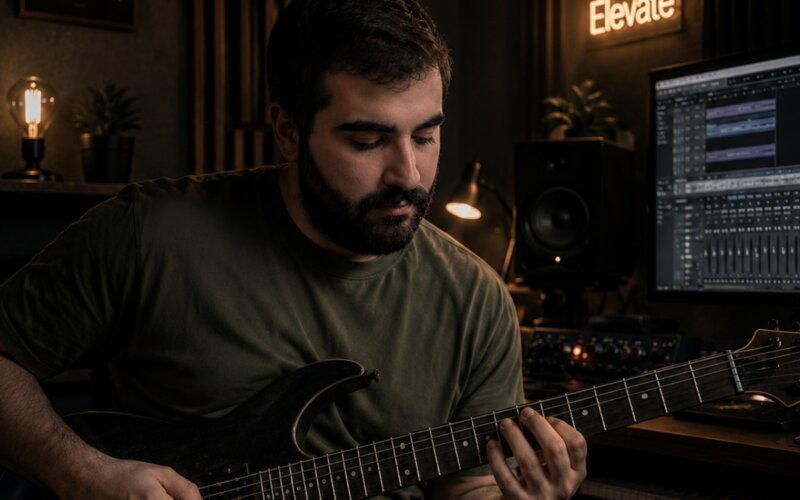
Most musicians have a folder of half-finished ideas they keep meaning to get back to. Serag Baddar had one riff, and he left it alone for about fifteen years, because he decided as a teenager that he wasn’t good enough yet to finish it properly.
That riff is now the backbone of “Limerence,” the Malta-based composer’s latest single, released on August 13 and clocking in at 4:10. Baddar is 30. The distance between the idea and the finished song covers half his life.
What made the riff worth saving wasn’t complexity. He remembers it as a melody that sounded professional at a point when he could barely play. “Even the way it’s played on the guitar, every note is placed conveniently where your hand can reach without having to stretch or move anywhere at all,” he says. “For me, as a 15 or 16-year-old, writing that riff meant I had a melody that sounded professional, and I was very proud of that because at the time I really sucked at my instrument.”
He wasn’t good enough at guitar or songwriting to turn it into the song he was imagining, so he put it aside with a promise attached, that he’d come back once he could do it justice. More than a decade passed before he did.
Back then the song was called “Lotus.” The title came from Buckethead’s “Padmasana,” which means lotus pose, and whose rhythm guitar shaped one section of Baddar’s track. Somewhere across the versions that followed, “Lotus” became “Limerence.” He’d been carrying it so long that letting go of it was its own adjustment. “The song has been with me as multiple iterations for so long I’ve gotten attached to it almost in its unfinished state,” he says. “Because so many versions of this song had things I wanted to keep but couldn’t.”
The version that survived is built on an idea he’d been circling for years. Baddar came up through groove metal, and what always grabbed him were the clean sections, the parts heavier bands tend to use as a break from the heavy parts. Opeth gave him one full record of it in “Damnation.” Tool gave him melodies he found incredible on every instrument. Buckethead gave him “Electric Tears” and “A Real Diamond in the Rough.” His question was simple enough: what happens if you never turn the distortion back on and let the clean, melodic side carry an entire song? “Limerence” is his answer, and he describes his music as catchy and accessible while still being original post-rock, which is an unusually plain description for something this deliberate.
The detail he’s proudest of is how the parts relate to each other. Instead of stacking instruments that shadow the same line, each one is doing something of its own. He makes that literal at the end of the track. The main riff plays, then stops. The bass comes in. The second guitar riff joins the bass. Then everything is played together once, and you hear the hook assembled from three pieces you’ve just been introduced to individually. It’s a small piece of engineering, and it does something most outros don’t, which is hand the listener the blueprint after they’ve already fallen for the building. “I’m very happy and proud of the fact that every instrument plays something completely different and sounds really good when put together,” he says.
The lyrics and vocal melodies came late in the process. Baddar calls the song his baby and says the words were always going to point inward. “It was more about me trying to give something special to a person, because I have a deeply personal tie with the song itself in a way that has nothing to do with that person at all,” he says. “So naturally, the lyrics were going to end up being about me alone.” They’re plain and repetitive by design, they reference “that metallica song” and later circle back to “and nothing else matters,” and they close on “Please talk to me” rather than any kind of resolution. The full lyrics and the single are on Bandcamp.
None of this happened on a schedule, and that’s the point. Baddar treats music as a hobby rather than a career, and he works on what he calls sparks, the bursts of creative energy where good material arrives without being forced. “There’s no pressure at all. I do whatever I want and release material at my own pace,” he says. “If there was ever a demand, I wouldn’t be able to keep up with it because of the way that I write, on sparks.”
His message to other musicians follows from that. Don’t get off on the cheap dopamine of having a song finished. Write out of love for the craft and keep working until it’s right, even if the wait runs into years. It’s not romantic advice, and it costs something. Baddar spent fifteen years earning the ability to record four minutes of music he wanted to hear as a teenager.
He doesn’t play live, and writing vocals for the rest of his clean material, including a bluesier, Kyuss-leaning track called “Electric Smoke,” will take time before it becomes an EP. So things stay quiet for now. He’s already proven he’s willing to wait.
You can find Serag Baddar at his website, on Instagram, on Facebook, and on Spotify.