






Getting a prescription online is easy now. That’s the whole pitch of the last few years of direct-to-consumer health startups. You fill out a form, a clinician signs off, a box shows up at your door. What almost none of them do is check whether the thing they prescribed is actually working for you, or adjust it based on real data over time. You get the prescription and you’re on your own.
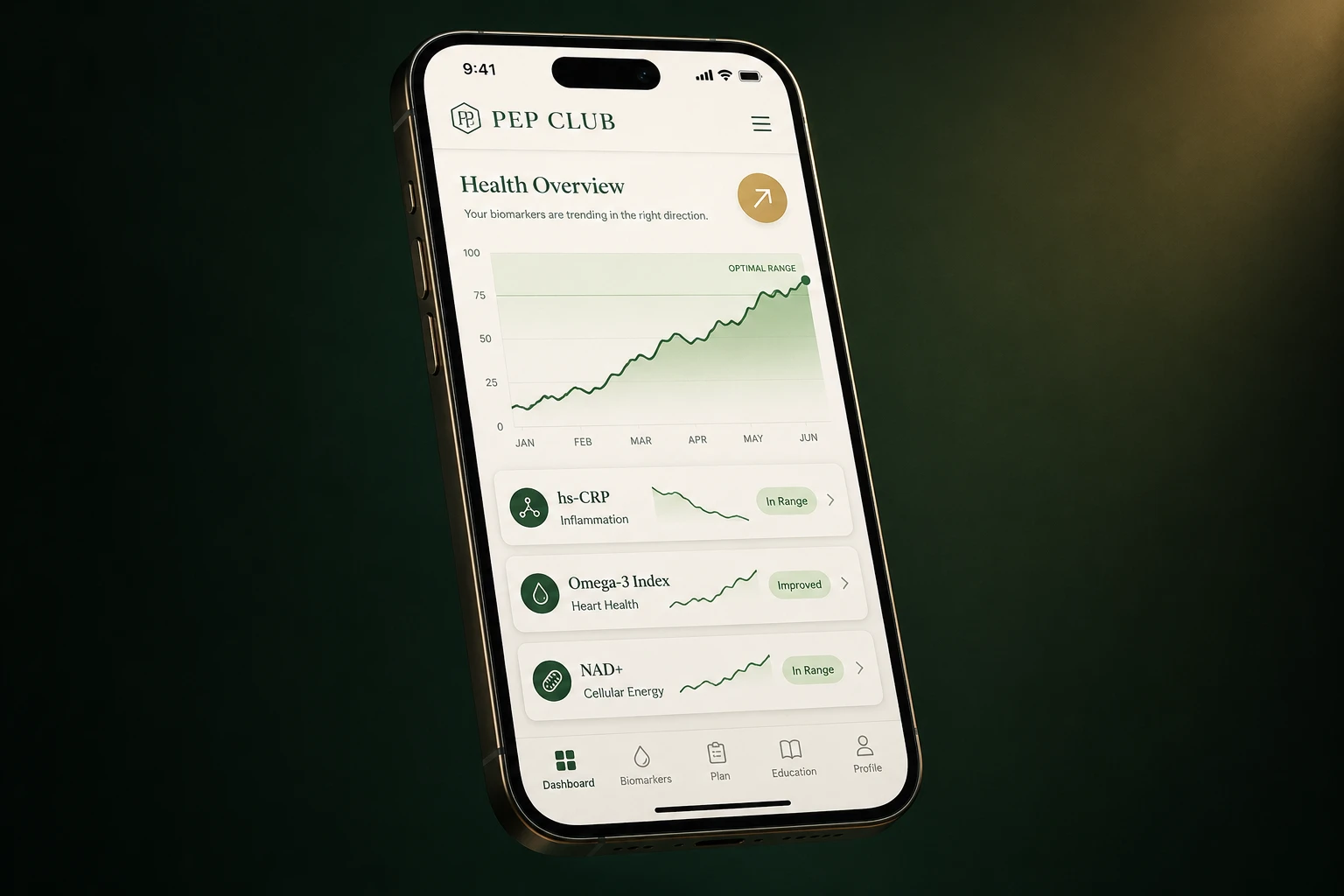
Pep Club, a New York-based telehealth platform that launched publicly on June 10, is built around that gap. The company pairs prescription and peptide care with monthly at-home blood testing, the idea being that a physician should be able to see your actual biomarkers before and during treatment, not just at the moment you sign up.
The testing piece is what sets the model apart. Instead of the single-drop fingersticks a lot of at-home services rely on, Pep Club ships a capillary collection device the company describes as near-painless, a fingertip or upper-arm pull that takes under five minutes. The sample goes back in a prepaid mailer, gets processed by a CLIA-certified lab, and results land in 48 to 72 hours mapped against reference and optimal ranges. For hormone markers specifically, the company requires per-analyte validation on its device before any result clears, and routes anything it can’t validate on capillary blood to a traditional venous draw instead of reporting it with low confidence. That’s a more cautious posture than the category usually advertises.

The formulary runs wide. More than a dozen categories, including hormone optimization, weight management, sexual health, hair restoration, skin and acne, IV and vitamin support, and a peptide menu. Medications are compounded by a licensed 503A pharmacy and require an active testing plan or recent labs within 90 days, so a physician has data to prescribe against. Pricing splits into two tracks: biomarker plans starting at $99 a month for a metabolic baseline, scaling to $249 for a 40-plus-marker longevity workup, with medication subscriptions billed separately on top.
Co-founder Greg Yuna put the thesis plainly. “Most online health platforms hand you a prescription and call it care. We wanted to build something more complete,” he said. The argument is that combining real testing with both prescription and peptide therapy under clinical supervision lets you personalize a protocol and keep refining it, rather than setting it and forgetting it.

That promise only means something if the clinical side holds up, and this is where Pep Club gets unusually specific. Compliance is the part of the site that reads least like marketing. Every physician is MD or DO, board-certified or board-eligible, and licensed in the patient’s own state, with no cross-state workarounds. They’re screened against the federal OIG exclusion list every week, on an automated check. And here’s the detail that actually matters to a patient: physician compensation is hourly or per-consult, never tied to prescription volume, product mix, or which pharmacy fills the script. The clinical entity and the technology company are separately owned, with a management agreement between them, which is the structure that keeps a telehealth platform from being a prescription mill with a doctor’s signature stapled on.
There’s also the pharmacy question. Pep Club’s affiliated compounding pharmacy is the standard fill because the agreements, formulary, and shipping are already wired up, but any prescription a Pep Club physician writes can be filled at whatever pharmacy you choose. That’s a real distinction in a space where some platforms quietly lock you into their supply chain. The compounding side runs through a licensed 503A pharmacy, which handles patient-specific preparations a physician determines are clinically appropriate for that individual. Defaulting to that pharmacy keeps the loop tight without making it the only door.
The rollout is deliberate. Pep Club only opens a state once both halves of the care loop are licensed there, a physician in the patient’s state and a pharmacy that can legally dispense there. That’s narrower than most telehealth platforms by design, and it’s why the platform is currently live in one state with the rest on a waitlist. A two-minute eligibility check confirms coverage up front, so you know exactly where you stand before anything else happens.
The bet Pep Club is making is that the next phase of consumer telehealth isn’t about prescribing faster, it’s about prescribing with evidence and adjusting with data. The structural choices, the testing-first loop, the volume-neutral pay, the open pharmacy policy, all point at a company trying to build the part of online care that everyone else decided to skip. You can see the full setup at thepepclub.com.